
Quick Answer First
Grinding usually means worn rollers or bearings. Squealing means something needs lubrication, often a dry hinge or roller. Popping or banging points to spring or balance trouble. Rattling means hardware has worked loose, which happens faster here thanks to humidity, salt air, and the wind-load stress that comes with hurricane-season storms. Here is how a technician actually narrows down each sound, in the order they'd check it, and what the fix involves.
Grinding: Metal-on-Metal Friction
What it sounds like
A deep, scraping or crunching noise as the door moves, often worse at the same point in the travel every time.
What gets checked, in order
- Rollers — are they cracked, flat-spotted, or missing a wheel bearing?
- Track alignment — has the track bent or pulled away from the wall, forcing rollers to grind against metal edges instead of rolling smoothly?
- Roller bearings — even if the wheel looks fine, a seized bearing inside will grind under load.
- Opener drive gear — on chain or belt-drive openers, a worn plastic gear inside the unit can grind as it strips.
The fix
Worn rollers get replaced, usually with nylon rollers instead of metal, which run quieter and hold up better against the humidity that speeds up metal fatigue. Bent track gets realigned or swapped out. A stripped opener gear means replacing that internal part or, if the opener is old, a full opener installation makes more sense than repeatedly patching it.
Squealing: A Lubrication or Friction Problem
What it sounds like
A high-pitched squeal, usually consistent and most noticeable when the door first starts or stops moving.
What gets checked, in order
- Lubrication — are the hinges, rollers, and track dry? Humidity actually washes lubricant off faster than you'd expect, and salt air near the coast accelerates the dry-out.
- Hinge pivot points — dry or slightly rusted hinges squeal as metal rubs metal.
- Roller bearings — a bearing on its way out will squeal before it starts grinding.
- Opener belt or chain tension — a loose belt can squeal against its pulley.
The fix
Most squealing clears up with a proper lubrication pass using a silicone or lithium-based garage door lubricant, not WD-40, which actually strips grease and attracts grit. If hinges show surface rust from humidity, they get cleaned or replaced before lubricating. This is exactly what a seasonal tune-up covers, and it's worth doing before hurricane season each year, not just when something starts squealing.
Popping or Banging: Spring and Balance Issues
What it sounds like
A sharp pop, bang, or thud, sometimes a single loud sound, sometimes repeated as the door moves.
What gets checked, in order
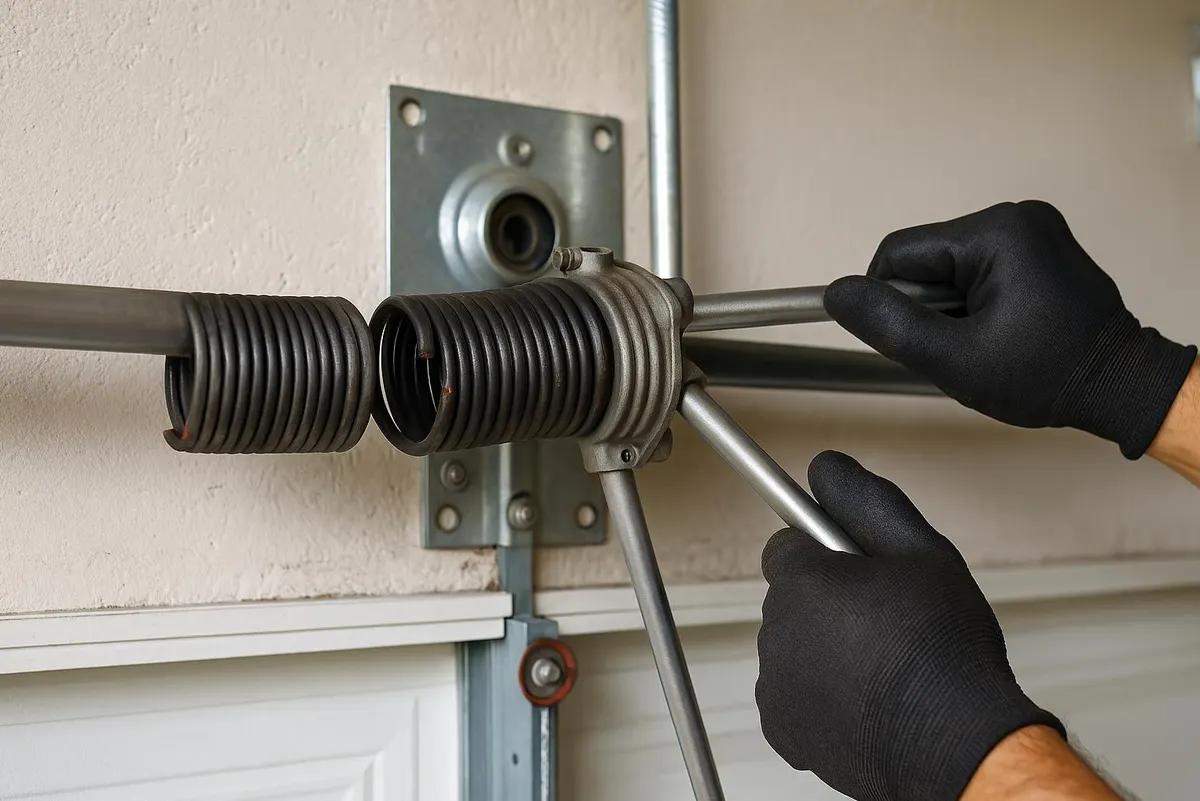
- Torsion spring condition — a spring under uneven tension, or close to failing, can pop as coils shift.
- Cable condition — a cable that's slipped off its drum will snap and bang against the track.
- Track for obstructions — debris or a bent section can cause a popping impact as the door passes.
- Panel seams — on wood or wood-composite doors, afternoon humidity swings and moisture absorption can swell panel joints, causing a popping or creaking sound as they expand and contract.
The fix
Spring issues are never a DIY job. A technician will check spring tension and balance, and replace the spring if it's stretched, rusted, or close to its cycle limit. Cables get rerouted and inspected together, since a failed cable often means the spring side needs a look too. Swollen panels from moisture need to be caught early with panel replacement before the warping affects how the door seals and seats, which matters for wind resistance during storm season.
Rattling: Loose Hardware
What it sounds like
A looser, shakier noise, often throughout the whole cycle rather than at one point, sometimes worse right after a storm.
What gets checked, in order
- Nuts, bolts, and brackets along the track and hinges — vibration from daily use loosens these over time, and wind load during storms accelerates it.
- Hinges — a hinge with play in it will rattle every time the panel flexes.
- Opener chain or belt slack — excess slack lets the chain slap against the rail.
- Track-to-wall mounting — brackets anchoring the track to the frame can work loose, especially on doors rated for wind load, where the whole system flexes more under gusts.
The fix
This is usually the simplest noise to fix: tightening every bolt and bracket to spec, replacing any hardware that's stripped or corroded from salt air, and adjusting chain or belt tension. After any significant storm, it's worth having this checked even if the door seems to work fine, since loosened hardware on a wind-rated door is a problem before it becomes an obvious one.
When to Call New Port Richey Garage Door Repair
If the noise is grinding or popping, stop using the opener and call us before the part fails completely, especially with springs. We handle Garage Door Spring Repair and Cable and Roller Replacement throughout Pasco County, and for squealing or general wear, our Garage Door Tune-Up & Maintenance service catches small issues before they turn into a stuck door during an afternoon storm. We serve New Port Richey, Port Richey, Trinity, Hudson, Holiday, Tarpon Springs, Palm Harbor, and Odessa.
If your garage door is making a noise it didn't used to make, call New Port Richey Garage Door Repair today and we'll have a technician out to diagnose it and get it fixed right.